
Coaches spend plenty of time discussing protein, carbohydrates and everyday food choices.
But athletes and active people also encounter probiotic supplements.
The challenge is understanding what those products actually contain.
Start with the terminology
Probiotics and prebiotics are different.
A probiotic is a live microorganism meeting a scientific definition involving a demonstrated benefit when administered in adequate amounts.
A prebiotic is a substrate selectively utilised by host microorganisms that confers a health benefit.
Some products combine the two ingredient categories.
Why strain identification matters
Probiotic products can contain different microorganisms.
Even products listing the same species may use different strains.
For example, Bacillus coagulans MTCC 5856 identifies a particular strain.
The strain designation is more specific than the species name alone.
What about CFU numbers?
CFU stands for colony-forming units.
It describes the quantity of viable microorganisms.
A large number doesn’t automatically establish that a particular formulation is preferable.
Coaches should be cautious about interpreting CFU counts without considering the strain and product information.
Understanding PHGG
Partially hydrolysed guar gum is a soluble dietary fibre derived from guar.
It is commonly abbreviated to PHGG.
Fibre powders vary in their physical characteristics, ingredients and preparation instructions.
A combined powder example
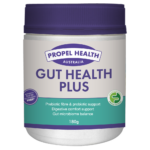
Propel Health Australia’s Gut Health Plus contains two ingredients:
- PHGG prebiotic fibre
- Bacillus coagulans MTCC 5856
Each 6 g serve provides approximately 5 g of dietary fibre and 1 billion CFU of the identified probiotic strain.
The powder is unflavoured and can be mixed into water, smoothies or food.
Why storage requirements differ
Some probiotic products require refrigeration.
Others are formulated for room-temperature storage.
Bacillus coagulans is spore-forming, and Gut Health Plus doesn’t require refrigeration.
What coaches should explain
An athlete’s nutrition routine should begin with ordinary foods, sufficient energy intake and practical meal planning.
Supplement discussions should then focus on the actual ingredients, serving instructions and individual circumstances.
Propel Health Australia’s best probiotics for gut health Australia page provides the Gut Health Plus formulation details.
For additional information about PHGG and other fibres, Gut Health Supplements is a related resource.
The coaching takeaway
Don’t judge a probiotic powder by its CFU count alone.
Identify the strain.
Check the fibre content.
Read the preparation and storage instructions.
And don’t assume that research involving an individual ingredient automatically establishes outcomes for a finished combination.
Good nutrition education starts with understanding what’s actually in the product.