
A running plan for beginners should get you running 5 km without stopping in about eight weeks, with three short sessions a week and no injuries along the way. This is the plan we use with new runners at our Samford gym, written by an accredited exercise physiologist, along with the strength work and warm-up that keep you on track.
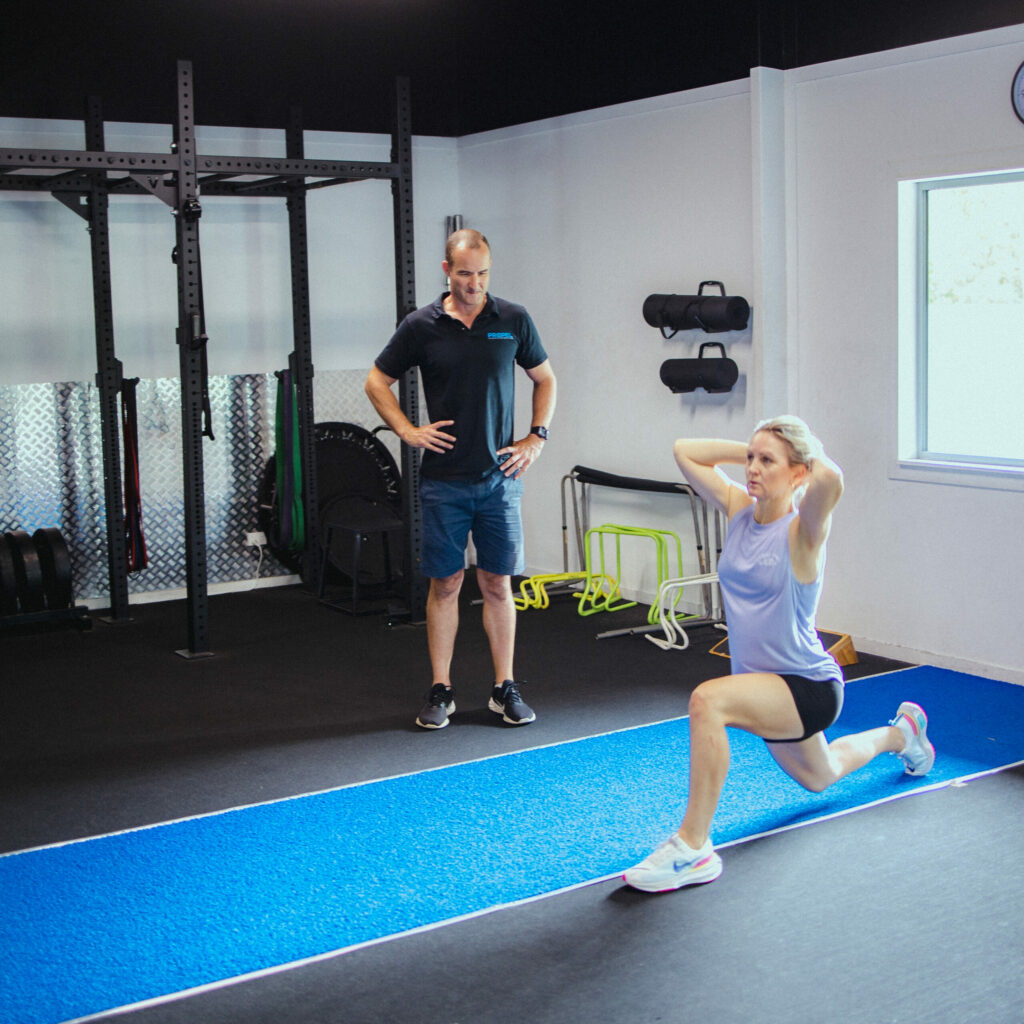
How the beginner running plan works
The plan uses walk-run intervals. You alternate short runs with walking breaks, and each week the running blocks get a little longer while the walking breaks shrink. By week eight the walking is gone.
- Three sessions a week, with at least one rest day between them. Monday, Wednesday and Saturday works well, and Saturday can be your local parkrun.
- Run at a talking pace. If you cannot speak in full sentences, slow down. Most beginners run too fast, not too far.
- Repeat a week whenever you need to. The plan moves when you are ready, not when the calendar says so.
The 8-week running plan for beginners
Every session starts with a 5 minute brisk walk and finishes with a 5 minute easy walk.
| Week | Each session | Total running |
|---|---|---|
| 1 | Run 1 min, walk 2 min, repeat 6 times | 6 min |
| 2 | Run 2 min, walk 2 min, repeat 5 times | 10 min |
| 3 | Run 3 min, walk 2 min, repeat 4 times | 12 min |
| 4 | Run 5 min, walk 2 min, repeat 3 times | 15 min |
| 5 | Run 8 min, walk 2 min, repeat 2 times, then run 4 min | 20 min |
| 6 | Run 10 min, walk 2 min, repeat 2 times | 20 min |
| 7 | Run 15 min, walk 2 min, run 10 min | 25 min |
| 8 | Run 30 min, or your first 5 km parkrun | 30 min |
If a week feels hard, repeat it. If you get through a week easily, you can still stay on schedule. The jump that catches most people out is week 5, so give it two goes if you need to.
Warm up before every run
A good warm-up takes five minutes and makes the first kilometre feel far easier. Do these after your brisk walk:
- Leg swings, front to back and side to side, 10 each leg
- Walking lunges, 8 each leg
- Calf raises, 15 slow reps
- High knees and butt kicks, 20 metres each
- Two 20 second strides at a comfortable faster pace
Add strength training twice a week
New runners usually stop because something starts to niggle, most often the calves, shins, knees or hips. Running is repetitive loading, and the tissues that take that load need to be strong enough for it. Two short strength sessions a week, on non-running days or after an easy run, make the biggest difference:
- Split squats or step-ups, 3 sets of 8 each leg
- Single-leg calf raises, 3 sets of 12 each leg, slow on the way down
- Glute bridges, 3 sets of 12
- Side plank, 3 sets of 20 to 30 seconds each side
If you would like this built around you, our strength training sessions in Samford do exactly that.
Running plan for beginners over 40
The plan works at any age. If you are over 40, or returning after a long break, take two weeks on weeks 1 and 2, keep the strength sessions non-negotiable, and give yourself 48 hours between runs. Recovery takes a little longer, and the plan should respect that.
What to eat and drink around your runs
For runs under 45 minutes you do not need anything special. Eat a normal meal two to three hours before, or a light snack such as a banana or toast an hour before if you run in the morning. Drink water through the day rather than gulping a bottle at the start line. Some runners like a beetroot smoothie before a run; if that is you, this guide to beetroot powder covers how to use it.
When to stop and get it checked
Muscle soreness the day after a run is normal. Pain that is sharp, gets worse as you run, or makes you limp is not. Stop, rest for a few days, and if it is still there, have it assessed. An exercise physiologist can work out what is being overloaded and adjust the plan so you keep running.
Your first goal: a parkrun
Week 8 lines up nicely with a Saturday parkrun. It is free, timed, and full of people who were once exactly where you are now. Walk some of it if you need to. Finishing is the goal.