
Tendon strengthening exercises are different from ordinary strength work. Tendons respond best to slow, heavy, controlled loading held under tension, not to fast reps or light weights. These six are the ones we use most at our Samford gym with runners, triathletes and athletes over 40.
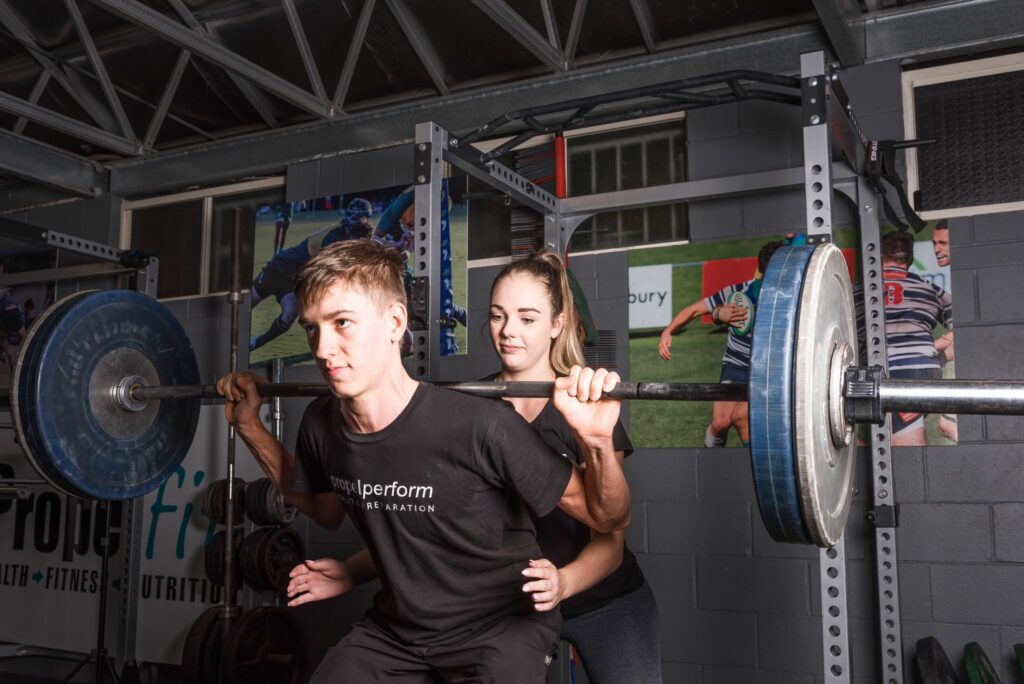
Why tendons need their own approach
Muscle adapts to training in weeks. Tendons adapt over months. That gap is why so many athletes feel fit enough to do more while their Achilles or patellar tendon says otherwise. Heavy, slow loading is the signal tendons respond to.
Six tendon strengthening exercises
| Exercise | Sets and reps | Area |
|---|---|---|
| Slow straight-knee calf raise | 3 x 8, 3 seconds up, 3 seconds down | Achilles, calf |
| Bent-knee calf raise | 3 x 8 slow | Achilles, soleus |
| Spanish squat with a band | 4 x 45 second holds | Patellar tendon |
| Slow split squat | 3 x 6 each side | Knee, hip |
| Isometric wall sit | 4 x 45 seconds | Patellar tendon |
| Slow external rotation with a band | 3 x 10 each side | Shoulder |
How often to do tendon strengthening exercises
Two or three times a week, with a day between. Increase the load gradually: add weight to calf raises once 8 slow reps feel steady. Expect change over 8 to 12 weeks, not days. Our strength training over 40 guide shows how to progress.
Common mistakes
- Going too light. Tendons respond to meaningful load. Ten easy reps does little.
- Going too fast. Slow lowering is where most of the benefit comes from.
- Stopping when it feels better. Tendon capacity keeps building for months. Keep a maintenance set in your routine.
Where it fits for runners
Runners over 40 benefit most from the calf and knee exercises. Add them to the end of your strength sessions, as in our running strength program.
Nutrition for connective tissue
Training is the main signal. Nutrition supports it: enough protein across the day, plus vitamin C. Some athletes also take collagen before training. Propel Health Australia covers the amounts and timing researchers use in their guide to collagen for athletes.
Common questions
Should tendon exercises hurt?
Mild discomfort that settles within a day is common. Sharp pain, or pain that is worse the next morning, means the load is too high for now.
Can I do these on rest days?
Yes. Isometric holds in particular work well on easier days and do not leave you sore for your next session.
How long until I notice a difference?
Most athletes notice more tolerance for training after six to eight weeks, with tendon changes continuing for months.
When to get it checked
If a tendon has been sore for more than a few weeks, is swollen, or is getting worse despite reducing load, see an exercise physiologist. A tailored loading program makes a big difference.