
Running strength program work is the fastest way to get faster and stay injury-free as a runner. Most running injuries come from tissues that cannot handle the load you are asking of them, and a targeted strength session twice a week fixes that. This is the program we use with runners at our Samford gym, written by an accredited exercise physiologist, covering what to do, how heavy, and how it fits around your running.
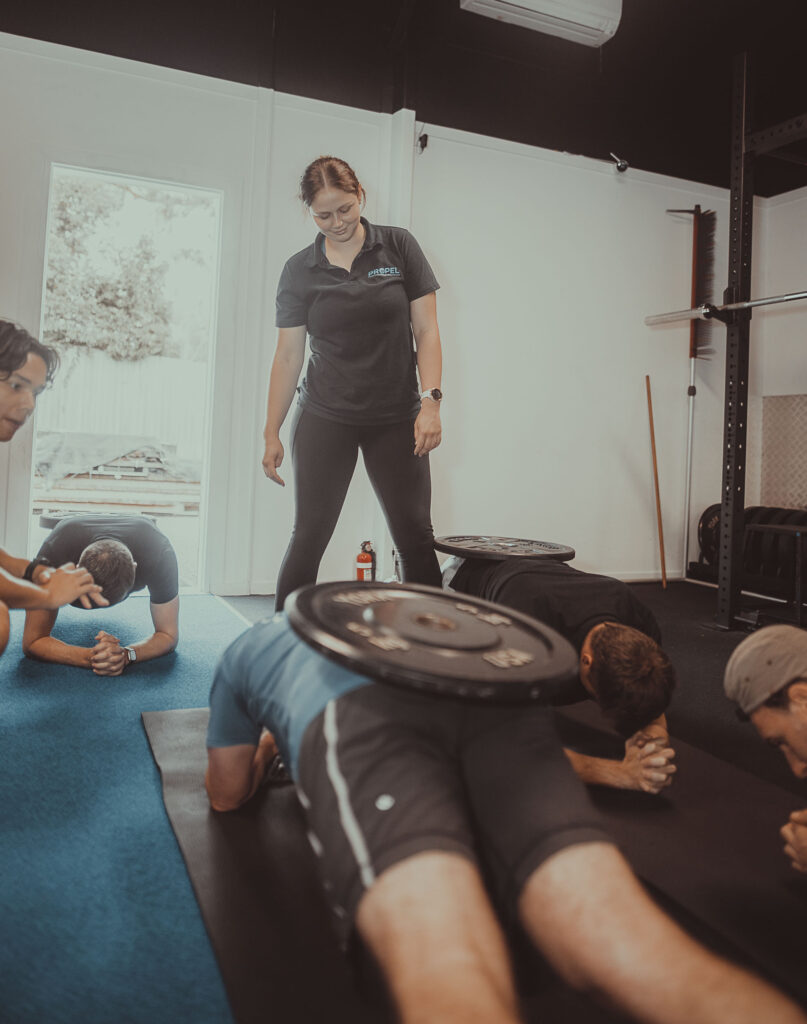
Why runners need a running strength program
Running is a series of single-leg hops. Every landing puts two to three times your body weight through one leg. If your calves, glutes and hamstrings are not strong enough to absorb that force, something else takes the load: your knees, your shins, or your lower back.
A good strength program does three things for a runner:
- Reduces injury risk. Stronger muscles, tendons and bones tolerate more running volume before breaking down.
- Improves running economy. You use less energy at the same pace because your muscles waste less force on each stride.
- Gives you a kick at the end. Fatigue-resistant legs hold form when others are falling apart in the last few kilometres.
The exercises
Single-leg work is the priority because running is a single-leg sport. We build every runner’s program around these six movements.
| Exercise | Sets x reps | Why it matters |
|---|---|---|
| Split squat (rear foot elevated) | 3 x 8 each leg | Quad and glute strength through a full range |
| Single-leg Romanian deadlift | 3 x 8 each leg | Hamstring and hip control on one leg |
| Step-up (knee height box) | 3 x 10 each leg | Mimics the push-off phase of running |
| Single-leg calf raise | 3 x 12 each leg | Calf and Achilles tendon capacity |
| Side plank | 3 x 30 sec each side | Hip and trunk stability to stop the pelvis dropping |
| Copenhagen adductor hold | 3 x 20 sec each side | Inner thigh strength, which runners often neglect |
Start with body weight or light dumbbells and build up over four to six weeks. When you can do the prescribed reps comfortably, add weight. The last two reps of each set should feel genuinely hard.
How to fit strength around your running
Two sessions a week is enough. Place them on easy run days or rest days, not on the same day as a hard interval session or a long run. A simple weekly layout looks like this:
| Day | Session |
|---|---|
| Monday | Easy run |
| Tuesday | Quality run (intervals or tempo) |
| Wednesday | Strength session 1 |
| Thursday | Easy run |
| Friday | Strength session 2 |
| Saturday | Long run |
| Sunday | Rest or walk |
If you are following a structured running plan such as our running plan for beginners or marathon running plan, slot the strength work in on the lighter days and drop to one session a week during a taper.
How heavy should you go?
Heavier than you think. Runners often stick with very light weights because they worry about getting bulky or sore. Neither happens when you keep the reps moderate and the recovery sensible. Aim for a weight where the last two reps of each set are a genuine effort. If you can cruise through all three sets, it is too light to create an adaptation.
For most runners we start with body weight for two weeks, then move to dumbbells. After a few months, a barbell for split squats and deadlifts is ideal.
Warming up
Five minutes of easy movement, then two or three warm-up sets at lighter weight. Our hip mobility drills make a good lead-in before a lower body strength session.
Common mistakes
- Doing strength after a hard run. You are already fatigued and your form suffers. Separate them or put the strength on its own day.
- Stopping strength work during race build-up. That is when you need it most. Reduce to one session a week, but do not drop it entirely.
- Only doing core work. Planks and sit-ups are fine, but they do not load your legs. The big single-leg exercises are where the injury protection comes from.
Nutrition around strength sessions
Eat a normal meal with protein and carbohydrate within a couple of hours of your session. If you train first thing in the morning, a small snack beforehand helps. Our guide to the best pre workout snack covers what works. Some people add a scoop of grass fed whey protein isolate Australia to a smoothie after training.
When to get it checked
If you are new to strength training, or if you have a recurring injury that flares up every time you increase your running volume, it is worth getting your program reviewed. An exercise physiologist can assess your movement, identify where you are weakest, and write a program that targets exactly what your running needs.