
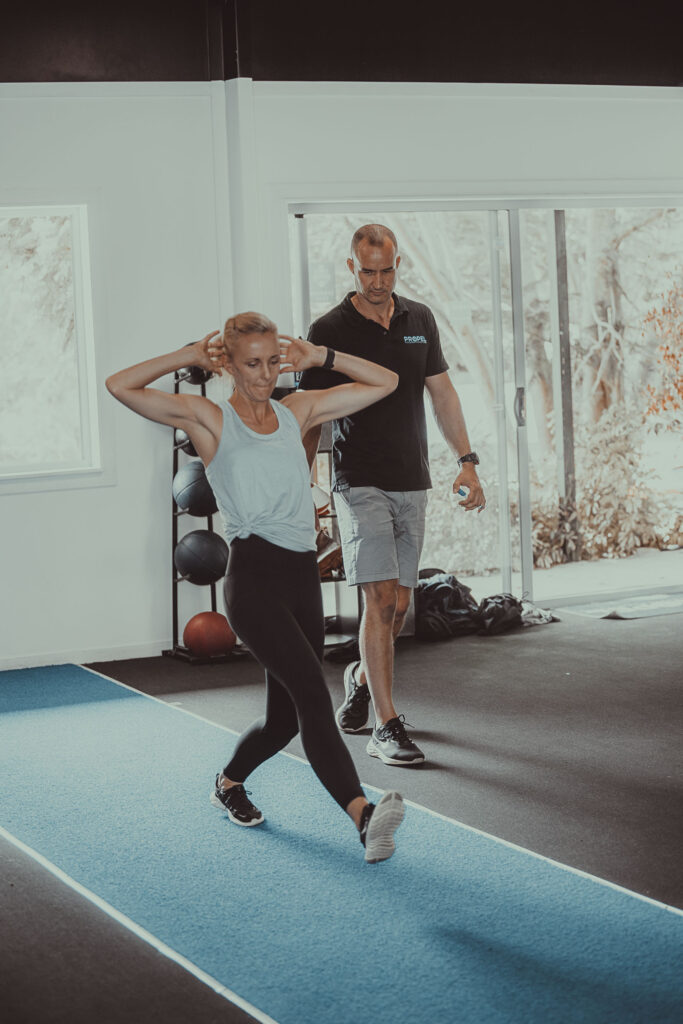
Warm up exercises prepare your muscles, joints and nervous system for the session ahead. Skipping them is one of the most common mistakes we see at our Samford gym, and it is one of the easiest to fix. A good warm-up takes five to ten minutes, costs nothing, and reduces the chance of pulling up sore or getting injured. Here is how to warm up properly, whether you are heading into a weights session, a run or a group class.
Why warm up exercises matter
A warm-up does three things. It raises your muscle temperature so the fibres contract and relax more efficiently. It increases blood flow to working tissues so they get oxygen sooner. And it switches on your coordination, so the first rep or stride feels controlled rather than clumsy. Research consistently shows that a structured warm-up reduces soft tissue injuries, and in our experience, people who warm up also perform better in the session itself.
A simple warm up exercises routine
This is the routine we use with most clients before a strength or general fitness session. It takes about eight minutes and requires no equipment.
- Two minutes of light movement. Walk briskly, jog on the spot, or ride the bike at an easy pace. The goal is to raise your heart rate gently.
- Leg swings, 10 each side. Hold a wall and swing one leg forward and back, then side to side. This opens the hips without forcing a stretch.
- Bodyweight squats, 10 reps. Go as deep as you comfortably can. Keep your heels down and chest up.
- Thoracic rotations, 5 each side. On all fours, place one hand behind your head and rotate your upper back towards the ceiling, then back down.
- Arm circles, 10 forward and 10 backward. Start small and gradually make them bigger.
- Inchworms, 5 reps. From standing, walk your hands out to a push-up position, pause, then walk your feet back to your hands and stand up.
If your session focuses on a particular area, add a few extra movements for that region. Our hip mobility drills guide has more options for the lower body, and our shoulder mobility workout covers the upper body in detail.
Gym warm up exercises
Before lifting weights, you need two layers of warm-up: a general warm-up like the routine above, then specific warm-up sets with the exercise you are about to do. Here is how to approach it.
| Step | What to do | Example (bench press at 60 kg) |
|---|---|---|
| General warm-up | 5 to 8 minutes of the routine above | Light movement, arm circles, thoracic rotations |
| Warm-up set 1 | Empty bar or very light weight, 10 reps | 20 kg x 10 |
| Warm-up set 2 | About 50% of working weight, 5 reps | 30 kg x 5 |
| Warm-up set 3 | About 75% of working weight, 3 reps | 45 kg x 3 |
| Working sets | Full weight, planned reps | 60 kg x 8 |
The warm-up sets should feel easy. Their job is to groove the movement pattern and prepare the joints, not to fatigue you before the real work starts.
Stretches before exercise
Static stretching, where you hold a position for 30 seconds or more, is not the best choice before training. It can temporarily reduce the muscle’s ability to produce force, which is the opposite of what you want. Save static stretching for after your session or as a separate flexibility routine.
Before exercise, use dynamic stretches instead. These are controlled movements through a full range of motion. Leg swings, walking lunges, high knees and arm circles are all dynamic stretches. They improve range of motion in the moment without reducing power output. If your ankles feel stiff before squatting or running, our ankle mobility drill is a good addition.
How long should a warm-up take?
For most people, five to ten minutes is enough. If you train early in the morning or you are over 40, you may need a little longer because your joints take more time to loosen up. If your warm-up is taking 20 minutes, you are probably doing too much. Keep it efficient and save your energy for the session.
When to get it checked
If you warm up properly and still feel stiff, restricted or sore in the same spot every session, that is worth investigating. A niggle that shows up during the warm-up and eases off might be fine. A niggle that gets worse as the session goes on, or that limits what you can do, needs attention. An exercise physiologist can assess what is happening and adjust your program so you train around it rather than through it. If you are already pulling up sore regularly, our guide to feeling sore after the gym explains what is normal and what is not.